 Supplier Nudge
Guide
Supplier allergen statement: what to ask for and when to renew it
What a supplier allergen statement should cover for a food plant, a request email you can send, and how to keep every statement current between audits.
An allergen statement is the supplier's signed declaration of which allergens are in a material they sell you, and which are handled where it is made. It is usually one page. Your allergen management program depends on it: the allergen matrix, the line schedule, the cleaning validation and the label all start from what each supplier tells you their materials contain.
This guide is written for the QA or food safety person collecting statements from suppliers, not the supplier filling one in. It covers what a useful statement says, a request email you can adapt, where gaps hide, and how to keep statements current. It is not legal or regulatory advice: your scheme's code, your customers' requirements and the labeling rules for each market you sell into decide what you must hold.
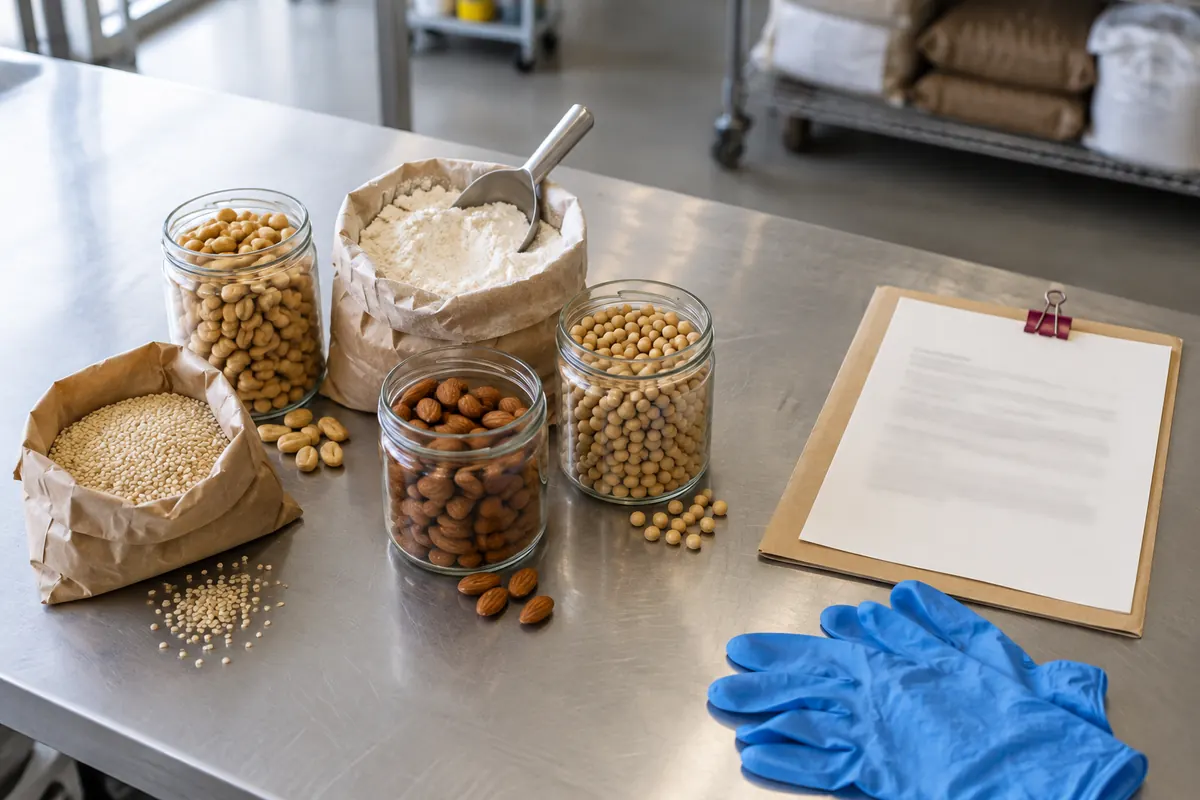
What the statement is for
A specification sheet tells you what a material is. A certificate of analysis tells you about one lot. An allergen statement answers a different question: could this material bring an allergen into your plant, either as an ingredient or through cross-contact at the supplier's site?
That is why a generic company-wide letter is weak evidence. The statement needs to be about the specific material, made at a specific site, because the same supplier can run sesame on one line in one plant and never touch it in another.
The allergens it should cover
In the US, the major food allergens are milk, eggs, fish, crustacean shellfish, tree nuts, peanuts, wheat, soybeans and sesame. Sesame was added by the FASTER Act and became the ninth major allergen on January 1, 2023.
Two practical consequences:
- Statements signed before 2023 may not mention sesame at all. A form that lists eight allergens and is silent on the ninth does not tell you the material is sesame-free. Ask again.
- Export markets use different lists. The EU lists 14 allergens, including celery, mustard, lupin, molluscs and sulphites. If you sell into other markets, ask suppliers to cover the union of the lists you need, and name those lists in your request.
What a useful statement says
Use this as a checklist when a statement comes in:
| Item | What to look for |
|---|---|
| Supplier and site | The legal name and the address of the site that makes the material, matching your approved supplier list |
| Material | Product name and code exactly as you buy it, not a product family |
| Each allergen, as an ingredient | Present or not present, for every allergen on your list |
| Each allergen, on site | Whether it is handled elsewhere in the facility |
| Each allergen, on the same line | Whether it runs on shared equipment, and how changeovers are cleaned |
| Precautionary labeling | Whether the supplier uses "may contain" or similar wording, and for what |
| Change commitment | A promise to tell you before a formulation, line or site change |
| Date and signature | Who signed, their role, and the date |
If any allergen is left blank, treat it as unanswered, not as absent.
Precautionary ("may contain") statements are voluntary in the US and practice varies between suppliers, so ask what the supplier's wording is based on rather than reading it as a test result.
A request email you can use
Send one email per supplier listing every material that needs a statement. Something like:
Subject: Allergen statements needed for [your plant name]
Hello [name],
As part of our supplier approval program we keep a current allergen statement for each material we buy from you. Please send a signed statement for each of these:
- [Material name, your code, their code] - [Material name, your code, their code]
For each material, please cover milk, eggs, fish, crustacean shellfish, tree nuts, peanuts, wheat, soybeans and sesame, and say for each one whether it is an ingredient, handled on site, or run on the same line. Please also tell us the address of the site that makes it and any precautionary labeling you use.
If your own form already covers this, that is fine. We would appreciate it by [date].
Thank you, [your name, title, phone]
Asking for every material in one message saves the supplier's quality team from answering five separate emails, and they are more likely to answer at all.
Where the gaps hide
Statements fail audits less often for what they say than for what they leave out:
- Wrong site. The statement is for the supplier's head office or a sister plant, not the site on your approved supplier list.
- Wrong material. It covers "all our flours" when you buy one blend that includes a seed topping.
- Missing allergen. Usually sesame, on an older form.
- No date or signature. You cannot say when the information was true.
- Out of date. Signed years ago, with no record of anyone asking whether anything changed.
How often to renew
No single rule sets the interval. Most allergen statements carry no expiry date, so your program sets one. Many plants ask for a fresh statement every 12 months and also whenever a supplier tells them about a formulation, line or site change, or a material's specification changes. Write the interval into your supplier approval procedure so it is a decision, not a habit, and use the same interval for every supplier of the same tier.
Because the statement has no printed expiry, the renewal date is the signature date plus your interval. That is the date to track. A register column for "date signed" with no renewal date next to it is how statements quietly go stale.
Keeping them current
The routine is the same as for any undated supplier document:
- Record the date signed and work out the renewal date from your interval.
- Ask early. Request the new statement 60 days before the renewal date, because suppliers' quality teams answer on their own schedule.
- Follow up on a schedule, not when you remember: a reminder at 30, 14 and 7 days, then weekly once it has lapsed, copying a second contact.
- Check what comes back against the checklist above before you file it, and keep the old one rather than overwriting it.
- Update your allergen matrix if anything changed, and tell whoever owns the line schedule.
Supplier Nudge does steps 1 to 3 for you. It treats an allergen statement as a document with no printed expiry: the renewal date is the issue date plus an interval you set, 12 months by default. Each supplier gets one upload link listing exactly what is missing or due, and is emailed at 60, 30, 14 and 7 days before the renewal date, then weekly for up to eight weeks after it lapses, until a current copy arrives. Checking what the statement says stays with you; Supplier Nudge collects and dates documents and never judges whether a supplier is approved.
Every supplier document current before your next audit, without chasing anyone yourself
Supplier Nudge sends each supplier one upload link listing what is missing, reads the expiry dates, and emails them at 60, 30, 14 and 7 days, then weekly for up to eight weeks after expiry.
$129/ month
Get startedCancel any time.