 POD Back
Guide
POD collection: getting missing PODs back from carriers
A broker billing desk's routine for POD collection, with when to ask the carrier, what to write, how often to follow up and when to pick up the phone.
Most carriers send the signed proof of delivery on their own, because they need it to get paid. The problem is the rest: the loads that delivered three days ago and still have nothing in the file. Until the POD is in, most shippers will not pay the invoice, and many brokers will not send it. So POD collection, for a broker, is really about the stragglers.
This guide is a routine a billing desk can run by hand today: when to ask, who to ask, what to put in the email, how often to follow up, and what to do when a POD finally arrives and something is wrong with it. It ends with a template you can copy.
Who has the POD
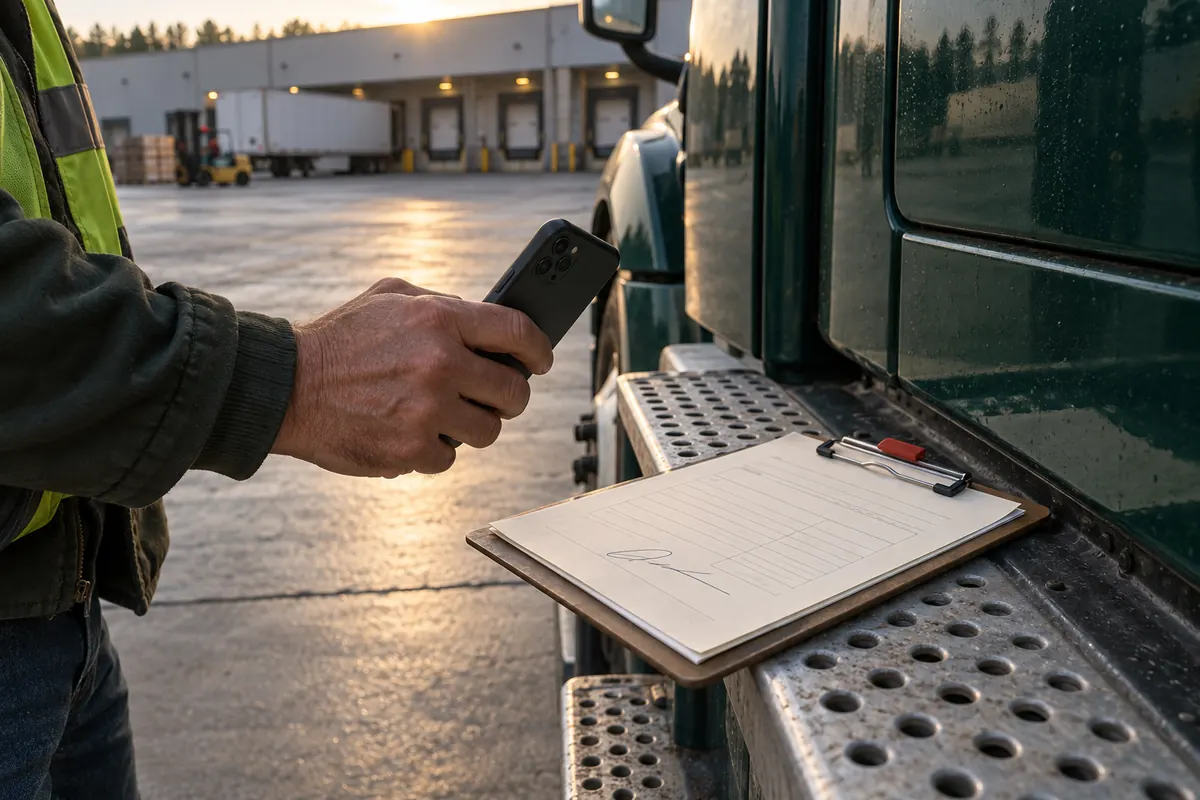
On a brokered load the signed POD usually passes through a few hands:
- The driver, who gets the consignee to sign the bill of lading or delivery receipt at the dock.
- The carrier's dispatch or back office, who collects the driver's paperwork to invoice you.
- A factoring company, if the carrier factors its invoices. The factor often receives the POD with the invoice and may hold the original.
- A tracking or driver app, if the carrier or your own team uses one to capture documents.
For a small broker the person to ask is almost always the carrier's dispatch or billing contact, the address on your rate confirmation. Drivers change loads and phones; dispatch knows where the paperwork went. If the carrier factors, ask dispatch first anyway: they can tell you whether the factor has it and send you a copy.
When to ask
Ask early, but not before the load could plausibly be done. A practical rhythm:
- A few hours after the delivery appointment. Four hours is enough for the driver to finish unloading, get the paperwork signed and send a photo. If there was no appointment time, ask late in the afternoon on the delivery date.
- The next morning. Dispatch inboxes are busiest at the start of the day, and a request that arrives first thing gets handled with the morning's paperwork.
- Once a day after that, for about a week. More than once a day reads as nagging; less than once a day lets the load slide.
- Then call. After a week of email with no answer, the load needs a person. Call dispatch, or ask your carrier sales rep to call the contact they booked with.
Two rules keep this from annoying your carriers. Send each carrier one email a day, listing every load you are missing from them, instead of one email per load. And do not email at night: a request that lands at 2 a.m. sits under everything else by morning.
What to put in the email
Dispatch handles paperwork for many brokers and many loads. Make your request easy to match and easy to answer:
- Your brokerage name and MC number, so they know who is asking.
- Your load number in the subject line, plus their own reference if you have it.
- The lane and delivery date, which is how most carriers file their paperwork.
- The PO or BOL numbers, which are printed on the document they are looking for.
- One clear way to send it: reply with the file attached, or upload it through a link.
- What counts: the signed delivery receipt or bill of lading, every page.
Leave out anything that is not needed to find the document. A short email gets answered.
Following up without starting over
Each follow-up should repeat the full request, not just say "following up on the below." Dispatch may never have seen the first email, or it may be buried. Add "Second request" or "Third request" to the subject so the urgency is visible, and keep the load number in the same place so it threads with the earlier messages.
Keep a simple record for each load: when you first asked, how many follow-ups went out, and when the next one is due. A spreadsheet with those three columns and a filter on "next follow-up is today" is enough to run the routine by hand.
When the POD arrives
Getting a file is not the same as getting a usable POD. Before the load goes to billing, check that:
- it is the delivery receipt or signed bill of lading, not your own rate con or the carrier's invoice sent back by mistake;
- your load, PO or BOL number is on it;
- the receiver signed it, and the signature area is not blank;
- the delivery date matches the load, give or take a day or two;
- there are no notes about overage, shortage or damage (OS&D), refusals or "subject to count";
- every page is there and readable.
Anything that fails one of these is not ready to bill. A POD with a shortage note, for example, can lead the shipper to short-pay or dispute the invoice, so it needs a person to look at it before it goes out. The POD document checklist goes through each item.
A request template
Copy this and fill in the brackets. It works as a first request and, with "Second request" added to the subject, as a follow-up.
Subject: Signed POD needed: Load [48213] ([Dallas, TX] to [Memphis, TN], delivered [Oct 14]) for [Your Brokerage]

Hi [Carrier] dispatch,

We still need the signed POD for the load below so we can bill it.

Load [48213], [Dallas, TX] to [Memphis, TN], delivered [Oct 14]. PO [7781], BOL [55102].

Please reply with a photo or PDF of the signed delivery receipt or BOL, every page.

Thank you,
[Name], [Your Brokerage], MC [000000]
All of the names and numbers above are examples.
Doing it without the routine
The routine is simple, but it takes someone's morning every day, and it is the first thing to slip when the desk is busy. That is the job POD Back does. You upload your rate confirmations or a CSV of delivered loads, and it emails each carrier's dispatch a few hours after delivery, then each morning, one email a day per carrier with a no-login upload link for each load. It checks every POD that comes in for a signature, the delivery date and your load number, sends anything with OS&D notes to you, and emails billing a list of loads ready to invoice each morning. Loads still stuck after the last follow-up come to you to call.
If you also want to tighten what happens after the POD is in, see the freight billing process, step by step.
Get every signed POD back from your carriers, and bill sooner
Upload your rate confirmations or a delivered-loads CSV. After delivery POD Back emails the carrier's dispatch for the signed POD, follows up until it arrives, checks it, and sends billing a ready-to-invoice list.
$99/ month
Get startedCancel any time.